Communicating with the User’s IP
Inside the main/scala/caravan/bus/common/Transaction.scala there are two abstract classes defined AbstrRequest
and AbstrResponse. The purpose of these classes is to provide a common interface for the bus adapters to
communicate with the user’s design.
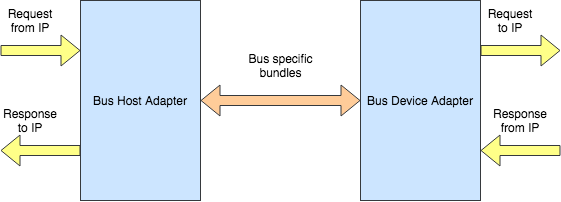
The yellow arrows indicates the common bundles that each bus adapter uses to communicate with the user’s IP. While the orange bundle indicates the protocol specific bus bundles between bus adapters.
abstract class AbstrRequest extends Bundle {
    val addrRequest: UInt
    val dataRequest: UInt
    val activeByteLane: UInt
    val isWrite: Bool
}
This class provides a standardized way for the user’s IP to send a request to the specific bus adapter or vice versa as shown above in the diagram. Since this is an abstract class, a concrete class is required to implement its fields which is usually done by a bus protocol specific class.
For example here is how the Wishbone implementation extends this class in the
main/scala/caravan/bus/wishbone/WishboneBus.scala file:
class WBRequest(implicit val config: WishboneConfig) extends AbstrRequest {
    override val addrRequest: UInt = UInt(config.addressWidth.W)
    override val dataRequest: UInt = UInt(config.dataWidth.W)
    override val activeByteLane: UInt = UInt((config.dataWidth/config.granularity).W)
    override val isWrite: Bool = Bool()
}
It sets the fields according to the parameterized widths it gets from its own config file
present in main/scala/caravan/bus/wishbone/WishboneConfig.scala
case class WishboneConfig
(
/**
* addressWidth: the address width in bits
* dataWidth: the data width in bits
* granularity: the minimal data transfer size over the bus
* waitState: whether the host can produce wait states during the bus transfer cycle
*/
addressWidth: Int,
dataWidth: Int,
granularity: Int = 8,
waitState: Boolean = false
) extends BusConfig
Similarly, the abstract response class present here main/scala/caravan/bus/common/Transaction.scala :
abstract class AbstrResponse extends Bundle {
    val dataResponse: UInt
    val error: Bool
}
is used by the bus protocol specific adapter to send response or error back to the user’s IP or vice versa as shown in the
diagram above. It is concretely implemented by the Wishbone specific implementation here: main/scala/caravan/bus/wishbone/WishboneBus.scala
class WBResponse(implicit val config: WishboneConfig) extends AbstrResponse {
    override val dataResponse: UInt = UInt(config.dataWidth.W)
    override val error: Bool = Bool()
}